
Falling Water

My seventh grade science teacher was something of an idealist when she recruited me and my friend Bridget as the founding members of Calloway County Middle School’s traveling science team. This was a risky move by Mrs. McDaniel because I didn’t actually understand things like cell structures or biospheres. I didn’t even really understand hydroelectric power, but that didn’t stop me from standing in front of a trifold poster and pretending I did. I pretended to understand hydropower for a whole year, at science fairs all over western Kentucky.
“When the water flows through this pipe, it turns these blades to produce electricity,” I would tell a gathered group of third-graders, pointing to the chart I had drawn with my own hands.
”How do the blades make electricity?” a kid might ask, rightfully, since he was under the impression he stood before someone who could answer such questions.
I hated the interrogation. I would exhale audibly and look back at my poster, hoping it held the answer. Hoping my own work was smarter than I.
“Because the blades turn and shoot the power up to the transformer, see.” I would point to the little yellow lightening bolts I had drawn with a Crayola marker, as if all the mechanics of energy transfer were made apparent in the stunning clarity of zig zags. I would plead with God that no further explanation would be requested, since we had arrived at the border of my understanding.
The kids would squint and tilt their heads.
“Hey,” I would shout, before they had time to string together any more words, “Want to learn a song?” I had prepared one with hand motions. It went something like: Fall-ing wa-ter… hydropower, hydropower.
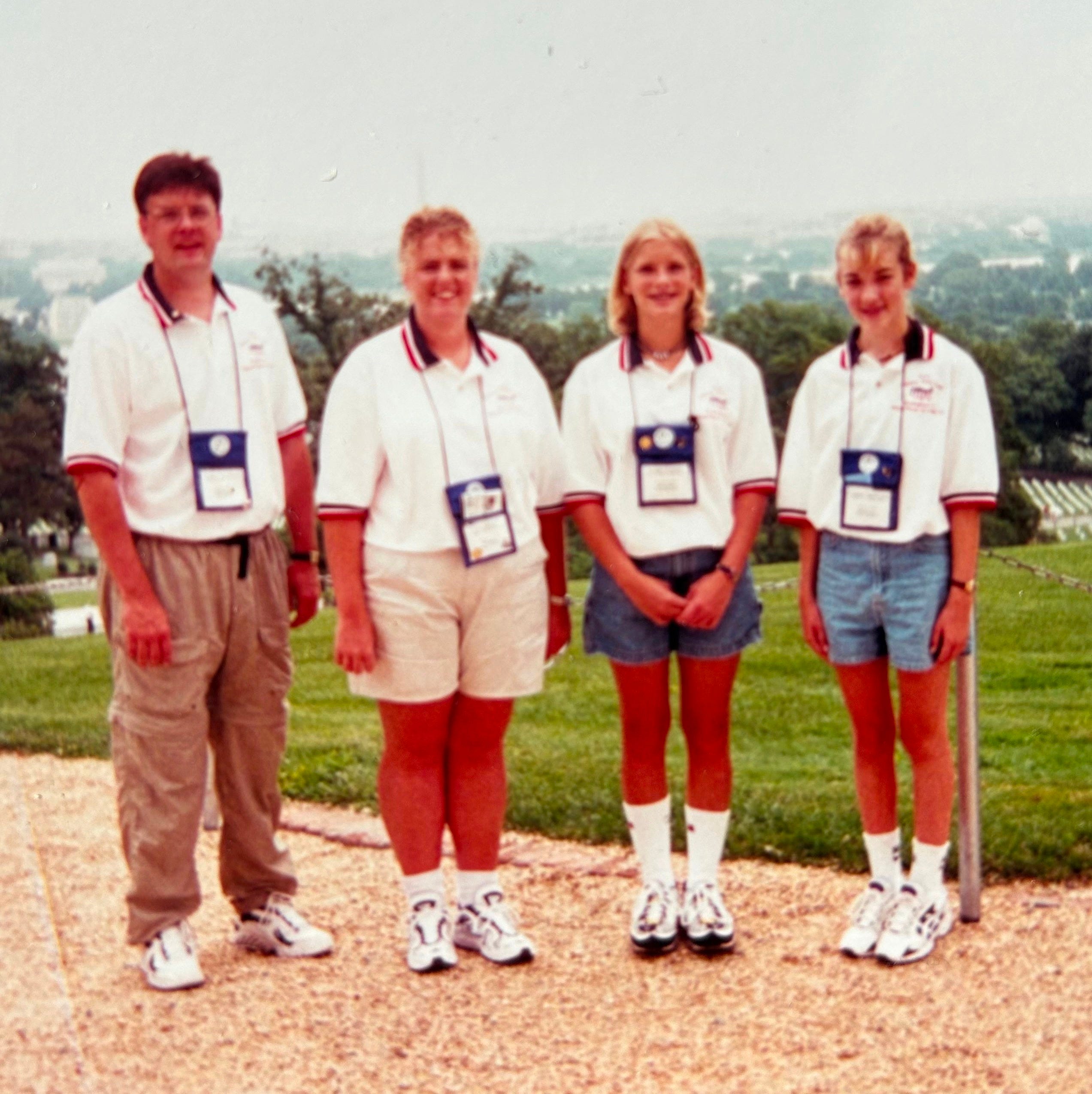
This sort of jazz-hands theatrics might have distracted some third-graders, but it did not impress the judges. Mrs. McDaniel realized she had made a grave mistake and Mrs. McDaniel had her eye on the prize: an all-expense paid trip to Washington, D.C. for the national science fair.
One day, she pulled Bridget and me into her classroom. “Okay girls, new plan: Scrapbooking!”
Mrs. McDaniel had discovered a category of the science competition in which even simpletons like me stood a chance: Science Team Scrapbooks. From then on, it didn’t matter if I could answer the judge’s questions about what a transformer does, so long as I could smile and take a nice picture at the end of the day. So long as I could glue it into a book and write a little note about what a good time I had at the science fair.
I can’t tell you how many other science teams used their after school hours cutting paper with scalloped-blade scissors, but I can tell you that Bridget and I produced the best science team scrapbook in the state of Kentucky in the year of 1997. And when we walked across the marble floor of the Kentucky State Capitol building to receive our certificate from Governor Patton, there was a whispered confusion in the crowd: “Did he say… scrapbooking?”
It occurs to me now that one of the reasons I have always struggled with science is that I am comfortable with mystery. How does the rushing energy of water falling over a dam turn on the lights in my house? There is no angst in my heart to know. There is only: Wow.
There was only wow that summer day of 1997, when I boarded an airplane for the very first flight of my life. There was only wow in the Smithsonian when I pressed my face against the glass to see the Hope Diamond. Only wow when I stood shrinkingly before the Lincoln Memorial.
And when we took a river cruise on the Potomac, with the rest of the science fair winners from all over the United States, Bridget and I threw our heads back in laughter as we jumped into a conga line. We wove in and out of the rooms of the riverboat dancing—out into the quiet darkness of the deck where we could see the lights of the city sparkling on the water, back into the bright and humming dining hall where our teachers laughed loudly with other adults. There was no chart to explain how we got there, these two scrapbookers in a conga line with young scientists. It was only wow.
And I suppose that’s why I was better at scrapbooking. And I suppose that’s why I write. I don’t know how the energy transfers. I don’t know why sometimes life is beautiful and sometimes it’s terrible. Sometimes the kindness of God sparkles like lights on the water. Sometimes the lights go out and He seems quiet and so far away. I come to the border of my understanding too often. All I know is that I exist, you exist, we exist, and it is wow, wow, wow to me. All I know is that beyond the borders is one who understands things too lofty for me, and that His glory comes down on us like the roar of rushing waters.
Once, someone told me that my writing was very “this-happened-then-that-happened.” She meant this at a compliment, but I found myself embarrassed at my lack of think pieces that seem to get the most traction in the writing world. I felt like that seventh-grader all over again, looking back at my trifold poster and exhaling. But I don’t think I need to distract you with any jazz hands, because this happened, and that happened: A little science fair charlatan found herself dancing on the Potomac. And don’t interrogate me on the mechanics of it, but doesn’t that falling water of glory—this tale from a world in which you also live—turn on a little light in your soul?
Sitting in the kitchen, reading this to my husband as we drink coffee, I'm laughing again and then crying. Though a couple of minutes earlier, he said he had no time for such things, when I finished, he looked up and said. "Wow. I have goose bumps."
I feel especially privileged that I got to hear the tune for “Fall-ing wa-ter… hydropower, hydropower” in person on Friday night. It now lives in my head rent-free.
Thank you for all the grace in this piece. At the risk of giving Mrs. McDaniels too much credit, I admire that she was able to turn water into wine in her own subcreator kind of way by turning water science into science scrapbooks. Well done, Mrs. McDaniels.
Also: seventh-grade Elizabeth is precious!